Skip to content

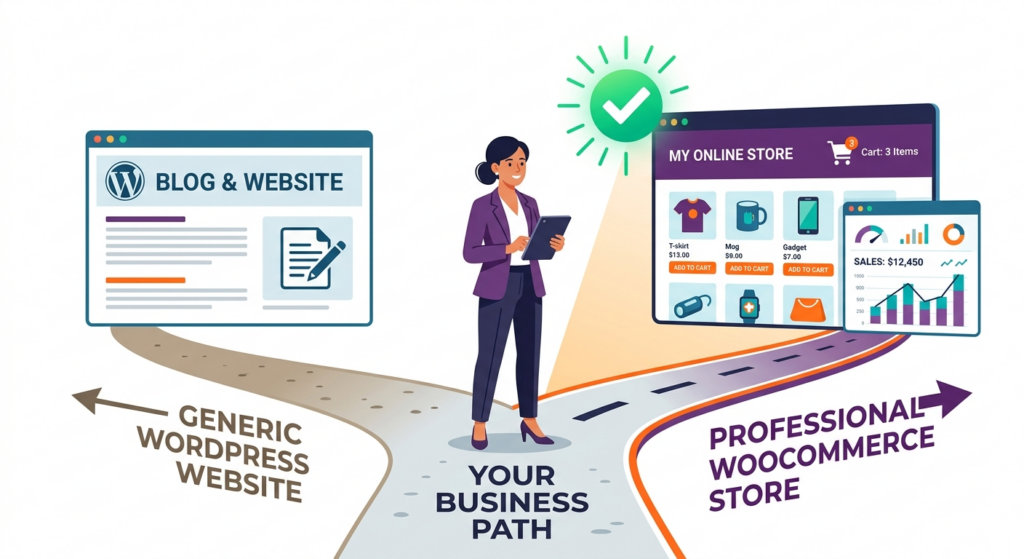
WooCommerce is a powerful platform with a vast ecosystem built around it. That brings clear advantages – but also a few challenges. In particular, there are so many WooCommerce professionals, agencies, and freelancers out there that it can be difficult to know who to choose or whether they’ll actually deliver a good result. If that’s where you are right now, this article is for you. We’ll break everything down and focus on twelve specific signals that separate genuine WooCommerce specialists from the rest. You’ll also get seven essential questions to ask in every discovery call, key red flags to watch out for, and a practical way to compare quotes on a like-for-like basis.
Key Takeaways
- WooCommerce is not generic WordPress. A “WordPress agency” is not automatically qualified to build a serious WooCommerce store.
- The twelve signals that separate a real Woo specialist from a generalist include three critical ones: a dedicated Woo portfolio, named Woo references, and a defined discovery process.
- If an agency quotes you a number before a discovery call, that number is fiction. Walk away.
- The seven questions below catch about 90% of bad-fit agencies in the first call. Ask every one of them, verbatim.
- Chemistry matters as much as credentials. The cheapest quote from a team you don’t trust will cost you more than the most expensive quote from a team you do.
Why this is the most important decision in your WooCommerce project
Choosing the wrong WooCommerce development agency is the most expensive mistake you can make on an ecommerce build. It costs more than a bad theme, a wrong plugin, or a missed launch date. It can cost you six figures, a year of opportunity, and in worst cases, the business itself.
We’ve been on both sides of this conversation. As Progressus — a certified WooExpert partner with 10+ years building WooCommerce solutions for companies like DHL, PostNL, Automattic, and Faire — we’ve been the agency hired to rescue mid-build disasters. As advisors, we’ve watched otherwise smart operators pick the wrong partner because they were optimizing for the wrong things — usually the lowest quote, the fastest start, or the best sales pitch.
This guide is the conversation we wish every store owner had before they signed a contract. It’s opinionated. It will probably eliminate a few agencies you’ve already been talking to. That’s the point. The goal isn’t to help you find an agency. The goal is to help you find the right agency for your specific build, your specific budget, and your specific risk tolerance.
By the end, you’ll have a checklist, a list of disqualifying red flags, a short script for the discovery call, and a clear framework for comparing proposals side-by-side.
The four things “WooCommerce agency” can mean (and why it matters)
Before we get into selection criteria, let’s define what we’re actually choosing between. In 2026, the phrase “WooCommerce development agency” gets applied to four very different kinds of shops:
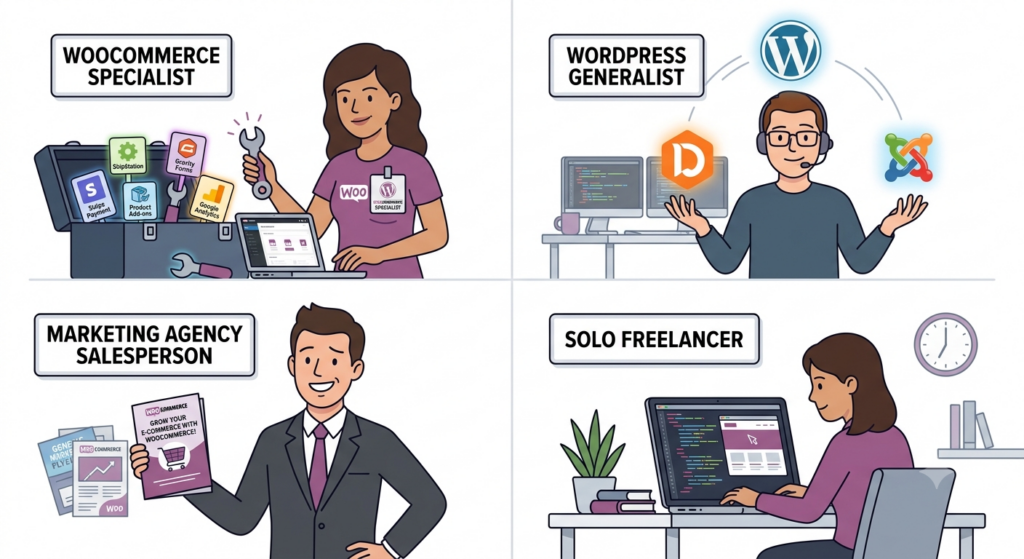
1. WooCommerce specialists (the only safe choice for serious builds)
These are agencies whose entire business is built on WooCommerce. They have a portfolio of named WooCommerce projects, their developers have shipped dozens of Woo builds, they have opinions about HPOS, checkout blocks, and headless architecture that are grounded in real production work, and they typically have direct relationships with WooCommerce ecosystem vendors (payment processors, ERP connectors, hosting providers).
Woo specialists are usually 5–30 people. They charge $100–$200 (€90-180)/hour in the US, CA, AU, UK, and EU. They are usually not the cheapest quote, and they are almost always the cheapest project.
2. WordPress agencies who also do WooCommerce
These shops do everything WordPress — marketing sites, blogs, LMS platforms, membership sites, and yes, WooCommerce. They have a few Woo projects in their portfolio, but Woo is not their main thing. Their developers can build a Woo store, but they don’t have a deep bench of Woo-specific expertise.
For a small launch (under 100 products, off-the-shelf theme, one payment gateway), this can be fine. For a mid-market or enterprise build, you will outgrow them. Their risk is that they will confidently say “yes, we can do that” to features that are genuinely outside their core competency.
3. Generalist digital agencies who took a WooCommerce course
These are SEO or marketing agencies that decided to offer “WooCommerce development” as an add-on service. They will subcontract the actual development to a freelancer or overseas shop. You will be paying a markup for what is, in effect, a freelance build with a sales wrapper.
The risk here is that you have no direct relationship with the people writing the code, and the agency has no ability to actually QA what was built. Avoid for any non-trivial project.
4. Freelance collectives and “agencies of one”
A skilled freelancer can absolutely deliver a great WooCommerce build. The risk is not skill — it’s continuity. If your freelancer is unavailable, sick, or just takes another higher-paying job, your project is at risk. There is no team redundancy.
For small, well-scoped projects, freelancers are great. For projects that have a deadline, multiple integrations, or a budget over $50K, the risk is usually too high. (See our full WooCommerce development cost breakdown for the math on when agency vs. freelancer makes sense.)
12 signals you’re looking at a real WooCommerce specialist
Use this as a scorecard. A real Woo specialist will hit at least 9 of these 12. A generalist will hit 4–6. Walk away from anyone hitting fewer than 4.
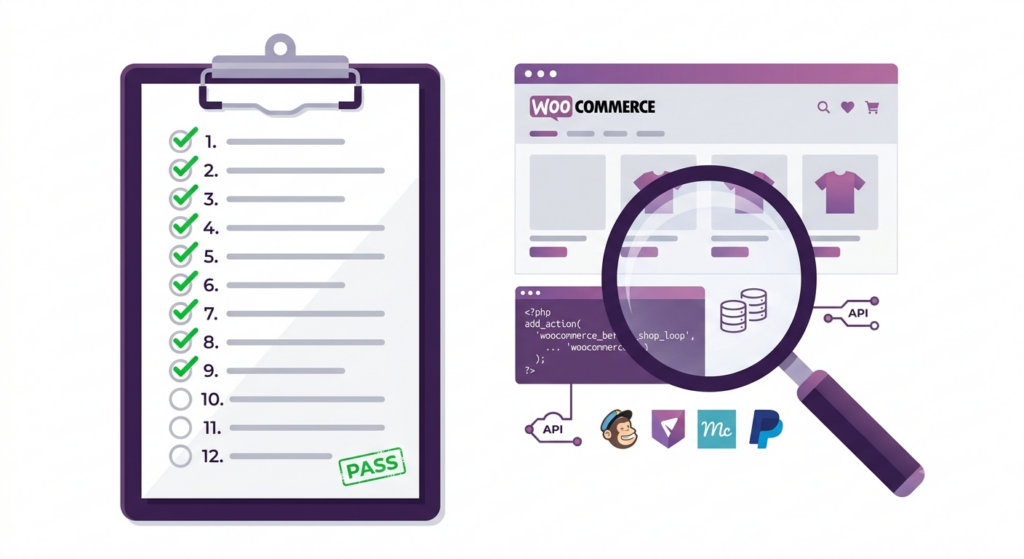
1. They have a dedicated WooCommerce portfolio, not just a “websites we’ve built” page.
Look for case studies that name the integrations (NetSuite, Stripe, Klaviyo, etc.), the scale (1K+ SKUs, 10K+ monthly orders), and the business outcome (revenue, conversion, performance). At Progressus, our case studies detail exactly this — from HPOS migrations eliminating crashes to payment plugin transformations and shipping integrations expanding to new markets.
2. They publish technical content about WooCommerce specifically.
Blog posts about HPOS, checkout blocks, custom plugin development, headless Woo, action schedulers, custom tables, the REST API. If their blog is all about generic WordPress and SEO, they are not a Woo specialist.
3. They name names on their stack.
Real agencies have opinions about which plugins they use and why. If they say “we use whatever fits,” they are not making informed decisions on your behalf.
4. They show code, architecture, or technical decision-making in their proposals.
A serious proposal discusses how your store will be structured, how integrations will be architected, what the data model looks like, and what edge cases they’re planning for. Our enterprise integration methodology details exactly what this architecture documentation should include.
5. They have a defined discovery process with a written deliverable.
Not “a call to discuss your project.” A real discovery is 1–3 weeks of structured work that produces a written SOW, architecture doc, or both. At Progressus, our discovery phase typically spans 2–4 weeks and produces a written integration brief with architecture sketches, data mapping, and risk mitigation before any code is proposed. For a typical mid-market WooCommerce build, a proper discovery phase costs between $1,000 and $5,000. That is not overhead, it is the cheapest insurance against a vague proposal that turns into a much more expensive project.
6. They will share references on request.
Real specialists have happy clients who will take a 15-minute call. If they can’t produce two or three references from comparable projects, ask why.
7. They have a real post-launch support offering.
A maintenance retainer, an SLA, a defined escalation process, an on-call rotation. “Just email us if something breaks” is not a support plan. Our WooCommerce support packages include weekly updates, 24/7 emergency support, uptime monitoring, cloud backups, and security optimization.
8. They are transparent about pricing structure.
Even if they won’t give a number before discovery, they will tell you whether they bill hourly, fixed-price, or value-based, and what their typical range is for projects like yours.
9. They ask about your business, not just your features.
Real specialists ask about conversion, retention, average order value, fulfillment, seasonality, growth plans. If the entire discovery call is about the visual design, they don’t understand ecommerce.
10. They have direct, named technical leadership.
There is a CTO, technical director, or lead architect whose name, background, and Woo experience you can verify. Not just a sales team. Meet our technical team to see how this works in practice at a specialist agency.
11. They contribute to the WooCommerce ecosystem in some way.
Open source contributions, public speaking at WooSesh or WordCamp, published plugins, partnerships with Woo.com. This is a soft signal but a strong one. Progressus maintains official plugins on WordPress.org and partners directly with WooCommerce.com.
12. They tell you when you don’t need them.
The best agencies will say “your project is too small for us, here’s a freelancer we trust” or “you don’t need a custom plugin, the existing one works fine.” Confidence to walk away is a signal of trust.
The 7 questions to ask in every discovery call
Run every agency you’re seriously considering through these seven questions. Ask them verbatim. Take notes. The answers will tell you almost everything you need to know.
1. “How many WooCommerce projects have you shipped in the last 24 months, and how many of them are live today?”
What you’re listening for: a specific number, a ratio of shipped-to-live, and confidence. A good answer is something like “We’ve shipped 14 WooCommerce builds in the last two years. 12 are still in production.” A bad answer is “We work with WooCommerce a lot” or “Several.”
2. “Who specifically from your team will work on my project, and what is their WooCommerce experience?”
What you’re listening for: named people, real Woo experience (not “they’ve done some Woo”), and stability. If the answer is “it depends on availability,” the people you talk to in the sales process are not the people who will build your store.
3. “What does your discovery process look like, what does it cost, and what is the deliverable?”
What you’re listening for: a defined process, a defined price (either free or fixed), and a defined output. If they say “we’ll just have a call and then send a quote,” they are skipping the most important phase of the project. For what a real discovery process should produce, see our enterprise WooCommerce integration methodology.
4. “Can you share two references from clients with projects similar to mine?”
What you’re listening for: a yes, and the references are similar in scope, scale, and vertical. If they say “we can’t share references due to NDAs” but won’t at least offer to arrange a call with one client under NDA, be cautious.
5. “What does post-launch support look like, and what is your typical response time on a P1 issue?”
What you’re listening for: a defined SLA, a real number (not “as fast as we can”), and a support contract you can buy. If they don’t have a support offering, your project ends at launch, and you’ll be on your own the first time something breaks at 2am on Black Friday. Our WooCommerce support packages include defined SLAs and 24/7 emergency coverage.
6. “If our project goes 30% over budget because we added scope, how is that handled?”
What you’re listening for: a written change-order process, transparency about hourly rates, and a clear approval threshold. Every project goes over scope. The question is whether the agency has a process for it or whether you’ll be arguing about it on an invoice.
7. “What would you do differently if you were building this store for your own business?”
What you’re listening for: an opinionated, specific answer. A real specialist will challenge some of your assumptions, suggest a different approach, and explain why. A vendor will just agree with everything you said. The point of hiring an expert is to get expertise, not to get validation.
Red flags that should make you walk away
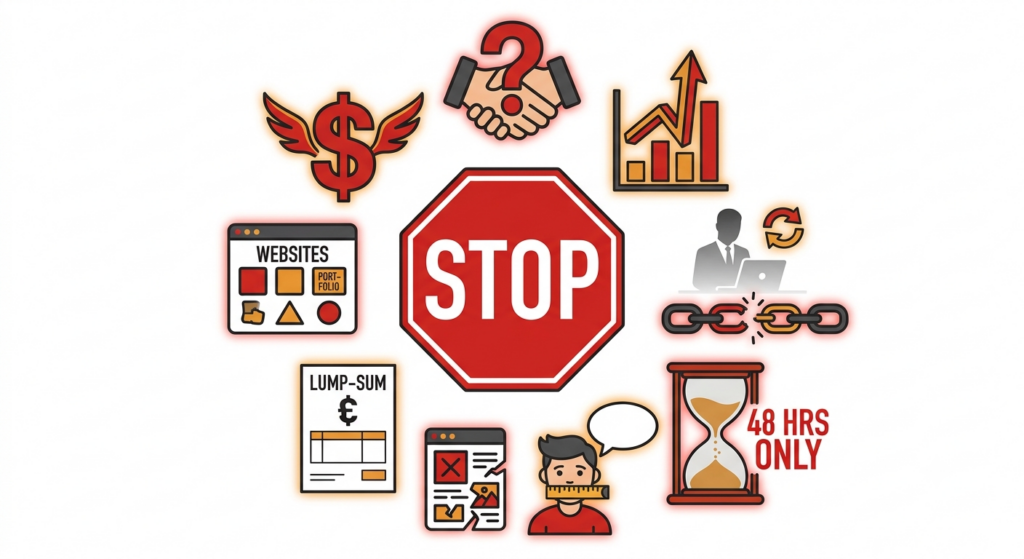
These are the disqualifiers. If you see more than one, do not sign.
- They quote a number in the first call. Anyone who can quote a WooCommerce project before a discovery is either lying or planning to bill you for the gap later.
- They have no Woo-specific case studies. “We’ve built lots of websites” is not the same as “we’ve built lots of WooCommerce stores.”
- They refuse to itemize scope in the proposal. A single lump-sum quote with no breakdown is uncompareable and unscopable.
- They don’t have a written contract. Verbal agreements and short MSAs are how disputes start. Get a proper contract reviewed by your lawyer.
- They guarantee specific business outcomes. No agency can guarantee revenue, conversion, or traffic. Anyone who does is either inexperienced or dishonest.
- They have high staff turnover. Ask how long their senior developers have been with them. If the answer is “less than 18 months on average,” you’ll lose institutional knowledge during your project.
- They subcontract the entire build. There’s a difference between bringing in a specialist for a specific piece of work and outsourcing your entire project. The first is fine. The second means you’re paying an agency to be a middleman.
- They pressure you to sign before you’ve had time to think. “This pricing is only good for 48 hours” is a sales tactic, not a project reality.
- They don’t ask hard questions. If the agency isn’t pushing back on your scope, timeline, or budget, they aren’t doing the job you hired them to do.
- Their own website is slow, broken, or out of date. A web agency that can’t maintain their own site is a warning sign.
How to compare WooCommerce proposals side by side
Once you have 2–4 proposals in hand, the hard part is comparing them. They will look like different documents written by different people in different industries. Here’s how to normalize them.
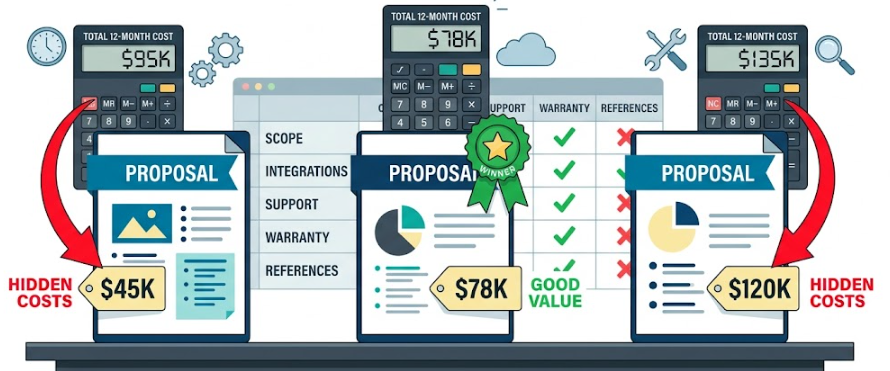
Build a comparison matrix
Put every proposal in a spreadsheet with these line items as columns. Score each agency on a 1–5 scale or with simple yes/no. The cheapest quote rarely wins.
- Itemized scope (yes/no)
- Named integrations and platforms (yes/no)
- Plugins and licensing specified (yes/no)
- Hosting assumptions stated (yes/no)
- Design and content scope defined (yes/no)
- Maintenance and support offering included (yes/no)
- Warranty period defined (yes/no)
- Change order process in writing (yes/no)
- IP ownership on day one (yes/no)
- Exit clause defined (yes/no)
- References offered (yes/no)
- Total fixed price or estimated range with hourly rate disclosed
Calculate total cost of ownership, not headline price
The cheapest proposal at signing is rarely the cheapest at year three. Add to each proposal:
- Annual plugin and licensing costs
- Annual hosting costs
- Annual maintenance retainer
- First-year major version upgrade cost
- Estimated cost of “minor” scope changes
Add these to the build price. The result is your realistic 12-month cost. Two proposals that look $40K apart at signing often end up $15K apart after TCO. For a detailed breakdown of what drives WooCommerce costs, see our WooCommerce development cost breakdown.
Score the people, not just the proposal
The agency is its people. The lead developer, the project manager, the architect — these are the people who will make or break your project. Ask to meet them before you sign. If the people in the sales meetings are not the people in the project meetings, the proposal is a fiction.
Most buyers underweight chemistry. Don’t. You will be in close contact with this team for 3–18 months. Mutual trust is a real project asset.
Where to find qualified WooCommerce agencies
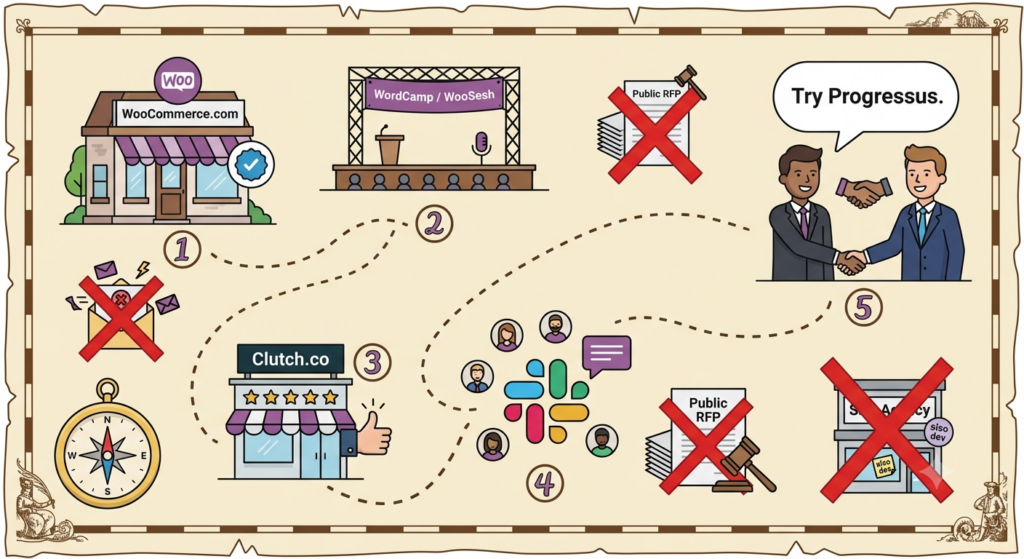
Most “how to find a WooCommerce agency” articles bury the answer. Here it is, directly:
- WooCommerce.com’s official partner directory. The agencies listed here have been vetted by Woo and have a direct relationship with the platform. It’s not a guarantee, but it’s a useful starting point. Progressus is listed as a certified WooExpert partner.
- WordCamp and WooSesh speaker lists. The agencies that send people to speak publicly about WooCommerce are usually the ones doing serious work.
- Clutch.co and DesignRush. Verified review platforms. Filter for WooCommerce specifically. Read the critical reviews, not just the 5-star ones.
- WooCommerce Slack and community. Ask other merchants. The honest answers in a Slack channel will save you a year of pain.
- Plugin vendor recommendations. If you know you need a NetSuite integration, ask the NetSuite connector vendor which agencies they trust. They see the code that comes out the other side.
- Direct referral from a peer. The single best source. Ask other store owners in your network or industry who built their store and what the experience was actually like.
What to avoid: cold outreach from agencies, agencies that bid on RFPs you posted publicly, agencies whose primary business is SEO or paid ads and who “also do development.”
What “good” actually looks like during the engagement
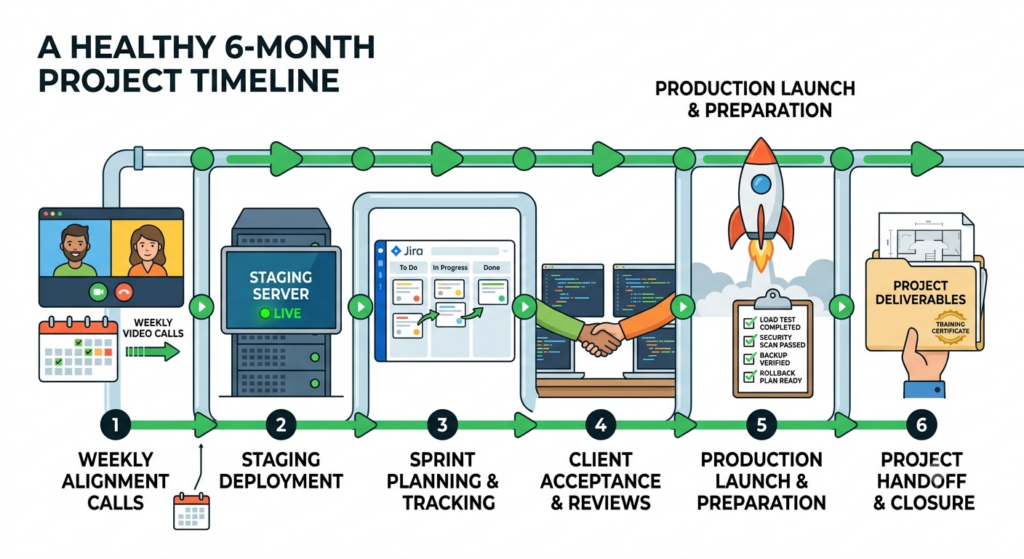
Once you’ve chosen an agency, here’s what a healthy engagement feels like:
- Weekly (or biweekly) status calls with a written summary of what was done, what’s next, and any blockers.
- A staging environment you can access at all times. You should never go more than two weeks without seeing real progress.
- A shared project board (Linear, Jira, ClickUp, Asana) where you can see every task and its status.
- Proactive communication about problems. The agency tells you about issues before you discover them.
- Realistic timelines that hold. If the project slips, you hear about it the same week, not the week of the missed deadline.
- A working relationship with the developers, not just the PM. You should be able to talk to the people building your store.
- A real launch rehearsal. Load testing, performance testing, security review, backup verification, rollback plan. Not a “let’s just push it and see.” Our enterprise methodology details the full deployment and hypercare process we follow.
- Documentation at handoff. Architecture diagrams, deployment procedures, admin training, a runbook for your internal team.
If you’re not seeing most of these, the engagement has gone off the rails. Address it in the first month, not the sixth.
When to fire your WooCommerce agency
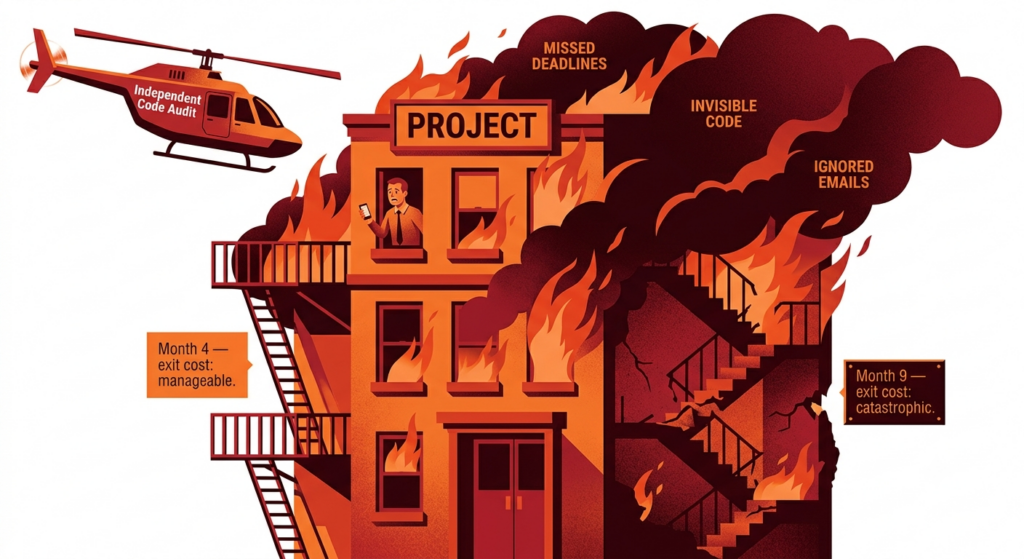
Switching agencies mid-project is painful and expensive. Sometimes it is still the right call. The signals:
- The project has gone 50%+ over timeline with no clear scope explanation.
- You’ve lost access to the staging environment, the project board, or the developers.
- The agency is no longer returning your calls or emails within a business day.
- You discover that the code being shipped doesn’t match what was proposed.
- The agency refuses to give you access to your own repository, staging, or production credentials.
- You’ve stopped trusting the people in the room.
If you see these signs, do not delay. The cost of switching at month four is much lower than switching at month nine. Get a code audit from an independent party, secure your IP, and start the transition. It is uncomfortable, but the alternative is launching a store you don’t trust on a deadline you can’t meet.
Conclusion: Optimize for fit, not for the lowest number
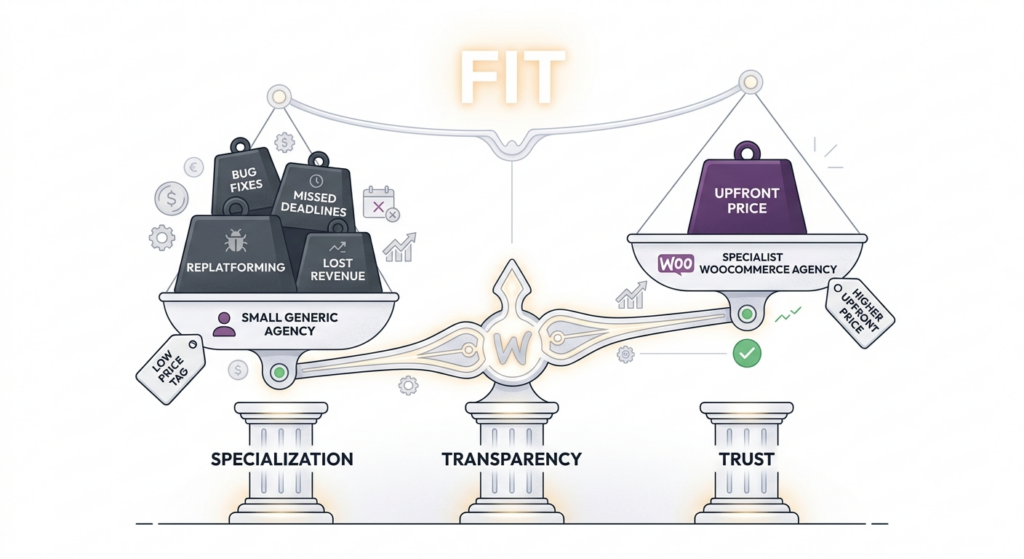
The cheapest quote from a generalist will cost you more than the most expensive quote from a real WooCommerce specialist. The math is straightforward. The emotional cost of a failed build is harder to quantify but is real.
When you’re choosing, optimize for three things: specialization (do they actually do WooCommerce?), transparency (will they tell you the truth about scope, timeline, and cost?), and trust (do you believe these are the people you want in the room with you for the next 3–18 months?).
Everything else — hourly rate, agency size, geographic location, fancy case studies — is a secondary consideration. The right agency for your build is the one that does this work every day, will tell you when you’re wrong, and will still answer the phone six months after launch.
If you’d like help evaluating a WooCommerce agency or want a second opinion on a proposal you’ve already received, we’re happy to take a look. We’ve reviewed enough WooCommerce proposals to spot the gaps in thirty minutes. Reach out via our contact page and we’ll send back a written assessment.
Frequently asked questions
How do I choose a WooCommerce development agency?
Look for a Woo-specific portfolio (not generic WordPress), named case studies with measurable outcomes, transparent pricing, a defined discovery process, in-house design and QA, a real post-launch support offering, and references you can call. Use the 7-question script in this article to qualify agencies in the first call.
How much does a WooCommerce agency charge?
Specialist WooCommerce agencies charge $100–$200 (€90-180)/hour in the US, UK CA, AU and EU. Total project cost depends on scope: small launches $5K–$10K, growth-stage stores $10K–$25K, mid-market builds $25K–$100K, enterprise rebuilds $100K+.
What’s the difference between a WooCommerce agency and a WordPress agency?
A WordPress agency builds WordPress sites of all kinds — blogs, marketing sites, LMS, membership sites, and ecommerce. A WooCommerce agency specializes in WooCommerce specifically, with deep expertise in extensions, integrations, payment gateways, performance optimization, and the WooCommerce data model. For serious ecommerce builds, you want a Woo specialist.
Should I use a freelancer or an agency for WooCommerce?
For small, well-scoped projects under $20-25K with a single developer of work, a freelancer is fine. For projects with 3+ integrations, real deadlines, multiple stakeholders, or budgets over $25K, a specialist agency is almost always cheaper in total because of project management, QA, and team redundancy. The risk with freelancers is continuity, not skill.
How long does it take to choose a WooCommerce agency?
Plan for 3–6 weeks from the start of your search to signed contract. That includes 1–2 weeks of initial research and outreach, 2–3 weeks of discovery calls and proposal review, and 1 week of contract negotiation. Rushing this process almost always costs more in the long run.
What questions should I ask a WooCommerce agency?
Ask: (1) How many Woo projects have you shipped in the last 24 months? (2) Who specifically will work on my project? (3) What does discovery look like and what is the deliverable? (4) Can you share two references from similar projects? (5) What does post-launch support look like? (6) How do you handle scope changes? (7) What would you do differently if this were your own store? The full script is in the article above.
What are red flags when choosing a WooCommerce agency?
Walk away if they quote a number in the first call, have no Woo-specific case studies, refuse to itemize scope, don’t offer a written contract, guarantee specific business outcomes, have high staff turnover, subcontract the entire build, pressure you to sign quickly, don’t ask hard questions, or have a slow or broken agency website.
Where can I find qualified WooCommerce agencies?
WooCommerce.com’s official partner directory, WordCamp and WooSesh speaker lists, Clutch.co and DesignRush with WooCommerce filters, WooCommerce Slack and community recommendations, plugin vendor recommendations, and direct referrals from other store owners. Avoid cold outreach and agencies that bid on public RFPs.
What’s the difference between discovery and a proposal?
A proposal is a quote and a high-level scope. Discovery is a 1–3 week structured process that produces a detailed SOW (statement of work), architecture document, fixed-price quote, and project plan. Discovery costs money (often $1K–$5K) but saves you from signing a vague proposal that turns into a much more expensive project. For what a thorough discovery process looks like, see our enterprise WooCommerce integration methodology.
How do I know if my current WooCommerce agency is the right fit?
You have weekly (or biweekly) status calls with written summaries, access to a staging environment, a shared project board, proactive communication about issues, realistic timelines that hold, a working relationship with the developers, a real launch rehearsal plan, and full documentation at handoff. If you’re missing several of these, the engagement has problems.
When should I switch WooCommerce agencies?
Switch if the project is 50%+ over timeline with no clear scope explanation, you’ve lost access to staging, code repositories, or the developers, the agency stops responding within a business day, the code doesn’t match the proposal, the agency refuses to give you access to your own credentials, or you’ve stopped trusting the people in the room.